 English
 كوردى
كوردى عربي
عربي
Perceived Realism and Risk Awareness in a Browser-Based Snow-Driving Simulation
Ziyad N. Aldoski,Csaba Koren,Dilshad Mohammed
https://www.mdpi.com/2673-7590/6/3/114
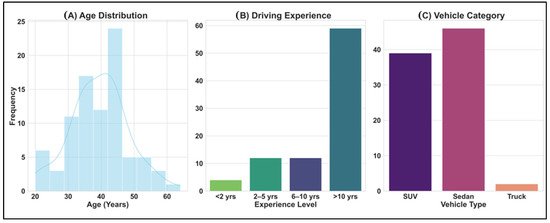
Driving in snow presents major safety challenges due to reduced visibility and slippery road conditions. Simulation-based tools may help improve hazard awareness; however, their effectiveness depends on how realistically they represent real-world driving experiences. This study examines the perceived realism and learning outcomes of a browser-based snow-driving simulation. A total of 87 licensed drivers with prior snow-driving experience interacted with a first-person browser-based simulation and subsequently completed a structured questionnaire. Composite indices were developed to measure Real-World Risk Perception (RWRP), Simulation Realism (SRI), Learning and Reflection (LEARN), and Awareness and Behavioral Reconsideration (AWARE). Quantitative analyses included reliability testing, descriptive statistics, correlation analysis, and multiple regression, complemented by qualitative thematic analysis. Results showed that perceived simulation realism was significantly associated with self-reported learning and awareness outcomes, whereas prior real-world risk perception was only weakly associated with post-simulation responses. Behavioral consistency between reported real-world and simulated driving behaviors was limited, suggesting that increased cognitive awareness does not necessarily correspond to behavioral equivalence. Qualitative findings identified limitations in vehicle dynamics, environmental complexity, traffic interactions, and emotional realism. Overall, the findings suggest that perceived realism plays a central role in shaping learning and awareness outcomes in browser-based driving simulations. The study highlights the educational potential of accessible web-based simulation environments while also emphasizing limitations in behavioral realism and transfer.