 English
 كوردى
كوردى عربي
عربي
Bayesian deep learning with selective inference for uncertainty-aware breast ultrasound classification
Zeravan Arif Ali a, Amira Bibo Sallow a, Masoud M. Hassan b
https://www.sciencedirect.com/science/article/pii/S1687850726001512
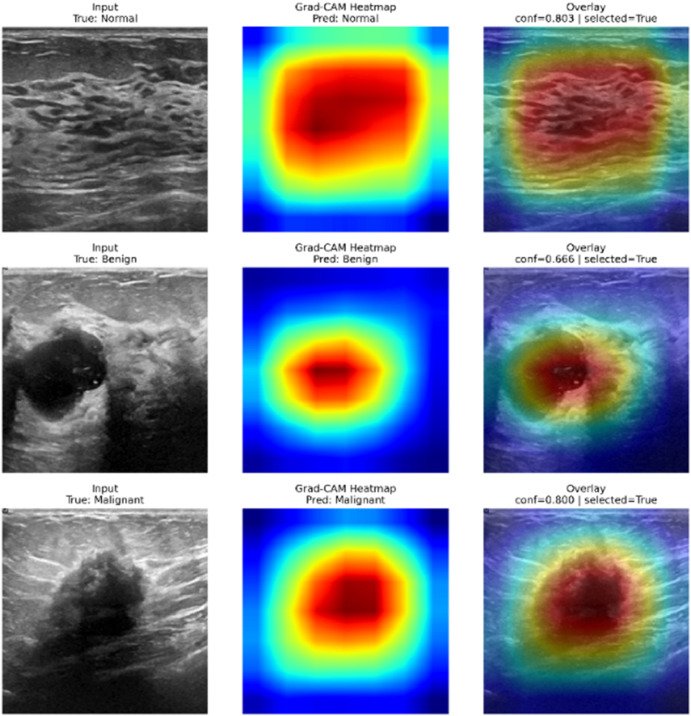
Early and precise classification of breast cancer using ultrasound (US) imaging plays a vital role in reducing diagnostic delays and improving patient outcomes. However, the inherently low contrast, speckle noise, and operator variability associated with US images pose significant challenges to conventional computer-aided diagnostic systems. To address these limitations, we propose a selective, uncertainty-aware Bayesian deep learning framework for automated classification of breast lesions using the Breast Ultrasound Images (BUSI) dataset. Our approach comprises three key components. First, we use a stratified Train/Validation/Test split before augmentation and apply class-aware augmentation only to the training set to support balanced learning and generalization. Second, the classification core is a hybrid ensemble combining ConvNeXt-Tiny and EfficientFormer-L1, trained with Focal Loss, mixup augmentation, and Monte Carlo Dropout to model epistemic uncertainty. Third, we apply a selective Bayesian inference strategy employing Monte Carlo Dropout, temperature scaling, and uncertainty-based filtering, to retain high-certainty predictions. Experimental results show 93.16% accuracy and 0.928 macro-F1 under standard unfiltered evaluation (bootstrap 95% CI: [0.880, 0.974]). Across five seeds, the final reported test results correspond to the aggregated multi-seed ensemble, and uncertainty is summarized using bootstrap confidence intervals. Using validation-derived confidence/entropy thresholds, selective inference achieves 97.26% accuracy at 62.4% coverage (73/117 retained) while maintaining performance across all three classes, including Normal cases. We further evaluate the framework on two external breast ultrasound datasets (BUS-BRA and BUS-UCLM) to assess robustness under domain shift. Overall, these results suggest that combining Bayesian uncertainty estimation with selective prediction improves the reliability and clinical practicality of breast ultrasound decision support.